James Madison's "Original Intent"
A Reply to Doug Henwood on the Mind of the Founder

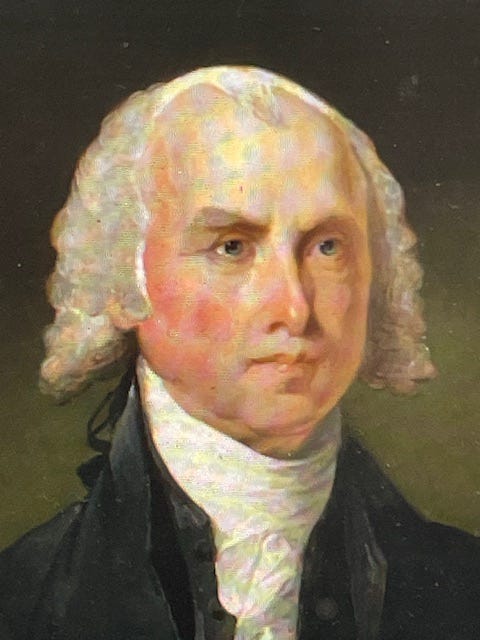
I
Doug Henwood, a stalwart of the Left from the socialist republic of Brooklyn, has recently accomplished what I thought was impossible or unnecessary—he has revisited and restated the Anti-Federalist case against the US Constitution. (Full disclosure: Doug is a personal acquaintance for whom I have the utmost admiration.)
https://jacobin.com/2026/07/an-aristocracy-by-design
This is a habit the Left indulges too frequently, mainly because it can. For it is only here in the US that the losers, deviants, miscreants, and malcontents get to write the history books that matter, and not as exiles like Leon Trotsky or Aleksandr Solzhenitsyn. If “America” is exceptional in any meaningful sense, that is how. Don’t take my word for it. Ask yourself why the Lost Cause of the Confederacy enjoyed at least a century of legitimacy, indeed hegemony, in the textbooks, or why the Populists of the 1890s remain the darlings of historians on the Left, and you will have the rudiments of an explanation for this exceptional intellectual phenomenon.
You will also understand why the Anti-Federalists seem to have carried the day, even unto this day, and on the Right as well as the Left. The products of the Federalist Society (!) who sit on the Supreme Court, for example, are unapologetically bent on a return to the pre-Constitutional state—it was not yet a nation—created by the Articles of Confederation.
Henwood takes to the pages of Jacobin to make the case against the so-called Founders. (see the link above). It’s an appropriate setting because under the spell of Robespierre, the Jacobins proved that when the project of revolution is reduced to radicalism—to the repudiation, indeed the erasure, of the past—it inevitably fails. Since Lenin and the Bolsheviks became the exemplary figures for the Left (and their antagonists became “revisionists”), the French Revolution has almost invariably appeared as the paradigm of revolution as such But the fact is that the French rendition of revolution sputtered to an ignominious end with The Terror, then the Bourbon Restoration, to be followed by a series of ragtag republics, clownish regimes, and abortive rebellions which finally expired with a whimper in 1940.
The American Revolution, by contrast, was a huge success by any measure, including the kind that would have us treat (progress toward) democracy as the essential criterion. It wasn’t a proletarian revolution, mind you, so the role of the working class—a social stratum that wasn’t the majority of Americans until the late 19th century, in any evnt—is irrelevant to its making, and to its interpretation (except as noted below).
And it is of course true that the so-called founders were wary of democracy, but largely because they still thought about historical time in the terms bequeathed them by civic republicanism, as a cyclical movement that made tyranny, oligarchy, and democracy moments on a rotating wheel that never unfolded to become a linear, cumulative development (hence “revolution” meant something like what R stands for in RPM, a turning that repeats as long as the energy source is animated).
II
Henwood nevertheless urges us not merely to ignore the legacy of the Revolution, but to repudiate it. In keeping with longstanding historiographical tradition on the Left, however, he assumes that the radicalism of the the revolution was repressed and mutilated by the Constitutional settlement of 1787-90. The generic narrative that follows from that assumption, a master text in its own right, goes like this:
From 1774 to 1787, the American Revolution was a de-centered, radical event driven by The People “out of doors,“ a motley, unwashed crew known variously as “the crowd,” committees of privates, Sons of Liberty, or “the mob,” and typically led by artisans like Sam Adams in Boston and/or itinerant n’er do wells like Tom Paine in Philadelphia. (The merchants who led the early stages of rebellion, ca. 1765-1771, had by then retreated from an increasingly diverse and unruly revolutionary coalition bent on independence from British rule, but also determined to wrest power from colonial elites.)
The new state constitutions written and ratified by this Leveller-like constituency were remarkably popular, in both senses—in Pennsylvania, for example, which was then the largest state, the constitution of 1776 (which Paine helped draft) abolished property qualifications for the vote and installed a unicameral legislature, to be balanced by a rotating council of censors that would pronounce on the merits of the laws it passed.
Other states didn’t go as far, but in almost every case the powers of the executive branch were strictly limited, the demographic reach of the electorate was considerably broadened, and the resultant legislatures looked much more like the whole of the people they represented (with the obvious exceptions, women and slaves; but free black men did, in fact, vote on the state constitutions and, later, ratification). The revolutionary war was financed and conducted by the states, with only secondary assistance from the Continental Congress—basically, it printed money—which, like the “United States” created by the Articles of Confederation in 1783, had neither mandate nor statutory authority to tax state revenues, imported goods, or individuals.
In such perspective, the Thermidor of the American Revolution—the conservative, nationalist counter-revolution against the Articles that triumphed with the ratification of the US Constitution in 1789 and was then enacted by Alexander Hamilton’s financial revolution—began in the mid-1780s, the “critical period,” when doubts about an “elective despotism,” which is to say doubts about majority rule, became a commonplace in all media, from the pulpits and the pamphlets to the broadsheets and the newspapers. In such perspective, the Constitution betrayed the radicalism of the revolution by removing the scene of sovereignty from the states to the nation.
III
I say that Henwood recapitulates this narrative even though he doesn’t bother with a capsule history of the period. For his criticism of the Revolution boils down to complaints against the undemocratic dimensions of the Constitution—and his indictment of the so-called Founders treats James Madison as the central figure in the making of the Constitution.
Fair enough. Let’s retrace Madison’s intellectual itinerary, to see what original intent actually was, implies, and still promises. Note, to begin with, that he was not a radical, even though he finally decided that the past had nothing left to teach him and his comrades about the making and the maintenance of republics. Note, more importantly, that his assumptions about the moral and political capacities of propertyless proletarians were widely shared in late-18th century North America, across all social strata. Just about eveyone knew that wage-earners were self-evidently dependent on their employers. If they became the majority, they would be ruled not by themselves but by those with more resources.
But look, before we can grasp the meaning of any revolution, we have to understand that democracy and majority rule are not the same thing, If they were, the states of the Jim Crow South, ca. 1890-1970, were democratic polities. There can be no doubt that the Senate, especially as hamstrung by the filibuster, urgently needs reform, or that the Electoral College is an ugly anachronism; but neither can there be any doubt that an amended Constitution is a better solution to our contemporary political impasse than a return to the Articles of Confederation, as the Supreme Court now demands, and as the Left has proposed, implicitly or explicitly, for roughly a century.
On, then, to Madison’s itinerary.
In early 1787, having made a detailed study of republics ancient and modern, he wrote a memo to himself called “Vices of the Political System of the United States.” This was a long rough draft of the famous Federalist #10. Here he worried about the multiplicity, the mutability, and the injustice of the laws passed by the various states under the diplomatic compact called the Articles of Confederation. But the big problem was the will of the people itself—an “elective despotism,” as Thomas Jefferson himself put it in 1783.
“If the multiplicity and mutability of laws prove a want of wisdom, their injustice betrays a defect still more alarming: more alarming not merely because it is a greater evil in itself, but because it brings more into question the fundamental question of republican Government, that the majority who rule in such Governments, are the safest Guardians both of public Good and of private rights.” [my italics]
Madison believed in the sovereignty of the people as the sine qua non of republican government. But he assumed that the defense of majority rule, and with it the possibility of a legitimate exercise of state power, required a logic that wasn’t circular—a logic that didn’t justify the power of the state, as expressed in law, by reference to power as such, in this instance the power of numbers.
In sum, Madison knew that a majority could be as despotic as any tyrant. What was to be done? How to contain or combat this despotic potential and thus preserve the substance and legitimacy of popular government? Neither a “prudent regard” for the common good nor “respect for character”—for elite opinion—was adequate, according to Madison. But piety was no help, either, because, like other “passions,” it could easily inflame oppressive majorities.
“The conduct of every popular assembly acting on oath, the strongest of religious ties, proves that individuals join without remorse in acts against which their consciences would revolt if proposed to them under the like sanction, separately in their closets. When indeed Religion is kindled into enthusiasm, its force like that of other Passions, is increased by the sympathy of a multitude.”
So, the way to establish a republic on enduring foundations was not to prevent but to prolong the process of majority formation, to devise, as Madison put it, “such a modification of the Sovereignty as will render it sufficiently neutral between the different interests and factions.”
IV
In place of prudence and character and piety—instead of respect for elite opinion and its attendant hierarchies—Madison proposed, then, to put the structural constraints of a constitution. By this I don’t mean only that he proposed a “limited government” circumscribed by rights guaranteed to individuals, or prerogatives reserved to the states (the Bill of Rights), as enforced by a judiciary that recognized the federalist separation of powers.
Of course he did. I mean also that his constitutional design, his “modification of the Sovereignty,” inscribed a difference, and a debate, between what he called “the two cardinal objects of Government, the rights of persons and the rights of property.”
It did so by adopting a “middle mode” through which the legislative branch was divided against itself, and each house became the effective voice of one of those “cardinal objects.” In this sense, Madison proposed to enlist historical time as the bulwark of justice in a society that would inevitably be riven by the differences between what he called “the Class with, and the Class without property”—he proposed to indefinitely prolong the debate between the social classes that had already appeared, in the 18th century, as the bearers of these different rights.
The class without property would defend the rights of persons in and through the lower house of the legislatures, including the Congress itself. The class that possessed it would defend the rights of property in the upper house. But both houses would be subject to periodic electoral discovery and pressure.
In a critique of Jefferson’s draft of a constitution for Virginia, Madison explained the historical grounds for this division of labor.
“This middle mode reconciles and secures the two cardinal objects of Government, the rights of persons, and the rights of property. The former will be sufficiently guarded by one branch, the latter more particularly by the other. Give all power to property, and the indigent will be oppressed. Give it the latter and the effect may be transposed. Give a defensive share to each and each will be secure. The necessity of thus guarding the rights of property was for obvious reasons unattended to in the commencement of the Revolution.”
V
All previous republics had collapsed because they could not balance “the two cardinal objects of Government,” the rights of persons and the rights of property. The great secret divulged by the history of republican government, Madison had found, was that there was nothing left to learn from that history. Except this: Either the rights of persons would be protected from the power of property, or the new American experiment would perish along with all the other attempts at government of, by, and for the people.
“In all the Governments which were considered as beacons to republican patriots & lawgivers the rights of persons were subjected to those of property. The poor were sacrificed to the rich. In the existing state of American population & American property, the two classes of rights were so little discriminated that a provision for the rights of persons was supposed to include of itself those of property, and it was natural to infer from the tendency of republican laws, that these different interests would be more and more identified. [my emphases]
“Experience and investigation have however produced more correct ideas on the subject.”
In other words, the study of history had forced a complete departure from classical and modern republican theory, Aristotle to Montesquieu. As he said in the constitutional convention on June 19, 1787, “According to the Republican theory indeed, Right & power being both vested in the majority, are held to be synonymous. According to fact & experience, a minority may in an appeal to force be an overmatch for the majority.”
He continued:
“It is now observed that in all populous countries, the smaller part only can be interested in preserving the rights of property. It must be foreseen that America, and Kentucky itself will by degrees arrive at this stage of Society, that is some parts of the Union, a very great advance is already made towards it “
Kentucky was shorthand for the most verdant lands on the trans-Appalachian frontier, a new Garden of Eden. If even that horizon was now clouded by class formation and the conflicts that came with it, then attending to the future of the republic was the urgent business of the present.
“It is well understood that interest leads to injustice as well where the opportunity is presented in bodies of men as to individuals; to an interested majority in a Republic, as to the interested minority in any other form of Government. The time to guard against this danger is at the first forming of the Constitution, and in the present state of population when the bulk of the people have a sufficient interest in possession or in prospect to be attached to the rights of property, without being insufficiently attached to the rights of persons. Liberty not less than justice pleads for the policy here recommended.
“If all power be suffered to slide into hands not interested in the rights of property which must be the case whenever a majority fall under that description, one of two things cannot fail to happen; either they will unite against the other description and become the dupes & instruments of ambition, or their poverty & dependence will render them the necessary instruments of wealth. In either case liberty will be subverted: in the first by a despotism growing out of anarchy; in the second, by an oligarchy founded on corruption.”
Notice that Madison doesn’t express fear of a proletarian revolution. Instead, he assumes that a propertyless majority would be the abject instruments of great ambition or great wealth. To be sure, this paragraph sounds like a Platonic prophecy, an acknowledgement that democracy was a dead end—except that Madison never doubted that majority rule was the necessary if not the sufficient condition of popular government. In the Constitutional convention, on June 26, 1787, for example, he said this:
“An increase of population will of necessity increase the proportion of those who labor under all the hardships of life & secretly sigh for a more equal distribution of its blessings. These may in time outnumber those who are [placed above the feelings of indigence. According to the equal laws of suffrage, the power will slide into the hands of the former. How is this danger to be guarded against on republican principles?”
In other words, how to preserve both liberty and equality? How to treat both the rights of property and the rights of persons as commensurable commitments? How to embrace majority rule without enabling an “elective despotism”?
Unlike some of his cohort, Madison never thought that a “natural aristocracy” of well-educated men with good character—an elite—could contain or guide the unruly energies of the proletarian masses. He always believed that the constitutional structures he designed would convert passions to interests, and that insofar as economic development created more and more interests, an oligarchy founded on corruption was unlikely if not impossible.
VI
He was wrong. An oligarchy founded on corruption has arrived, without apology. Every day it sacrifices the poor to the rich with impunity, pretending that the highest possible morality still attaches to the disgusting morbidity residing in the pursuit of profit.
But that is no reason to relinquish Madison’s insights into republican government and the democratic possibilities that flow from it. The Declaration of Independence and the US Constitution were moments on a continuum, as he understood them, and as Theodore Weld, Angelina Grimke, Frederick Douglass, Abraham Lincoln, Martin Luther King, Jr., and Fannie Lou Hamer did as well. Promissory notes, MLK called them.
Once again, they’ve come due. We can redeem them, but only if we realize that the radicalism of the American Revolution was both annulled and preserved in the Constitutional settlement. Like the principal of a long-term investment, the principle remains. And so does the interest, Doug.
For me, one of Madison's most fascinating ideas was his demand for a federal veto over state laws. He fought for it, didn't get it, and complained about that for the rest of his life.
When did the Populists become darlings of historians of the left? Not a rhetorical question. Marxist-Leninists never liked them much, and the post WWII Democratic/center-left intelligentsia (Lippmanm, Hoftadter, Daniel Bell, probably Galbraith) held them in contempt. (Schlesinger thought that later populists were OK to the extent that they supported the Democratic machine.